
Why Rudrabhishek in Sawan multiplies your punya
The Shiv Purana calls Shravan the month when Shiv drank halahal and accepted the Ganga on his jata. Every offering in this month reaches him faster — here's why.
By Dr. Dataram Mishra · 1 July 2026
Shravan (Sawan) is not just another month in the Hindu calendar. It is the month Lord Shiv chose to accept the churning of the ocean's poison — halahal — to save creation. That single act of selflessness makes the month itself charged with his presence.
The scriptural basis
The Shiv Mahapuran (Kotirudra Samhita) declares that during Shravan, Bhagwan Shiv resides on Earth rather than in Kailash. Every bilva patra offered equals a thousand poojas performed in other months. Every drop of Ganga jal offered on the Shivling washes away accumulated karma of many births.
Why Somvar (Monday) is special
Monday is Shiv's own day — the day associated with the moon, which resides on his jata. In Shravan, when Monday and Shravan combine, the punya is doubly multiplied. There are usually 4 or 5 Sawan Somvars each year — devotees traditionally fast on all of them, breaking the fast only after evening Shiv aradhana.
Rudrabhishek — the highest offering
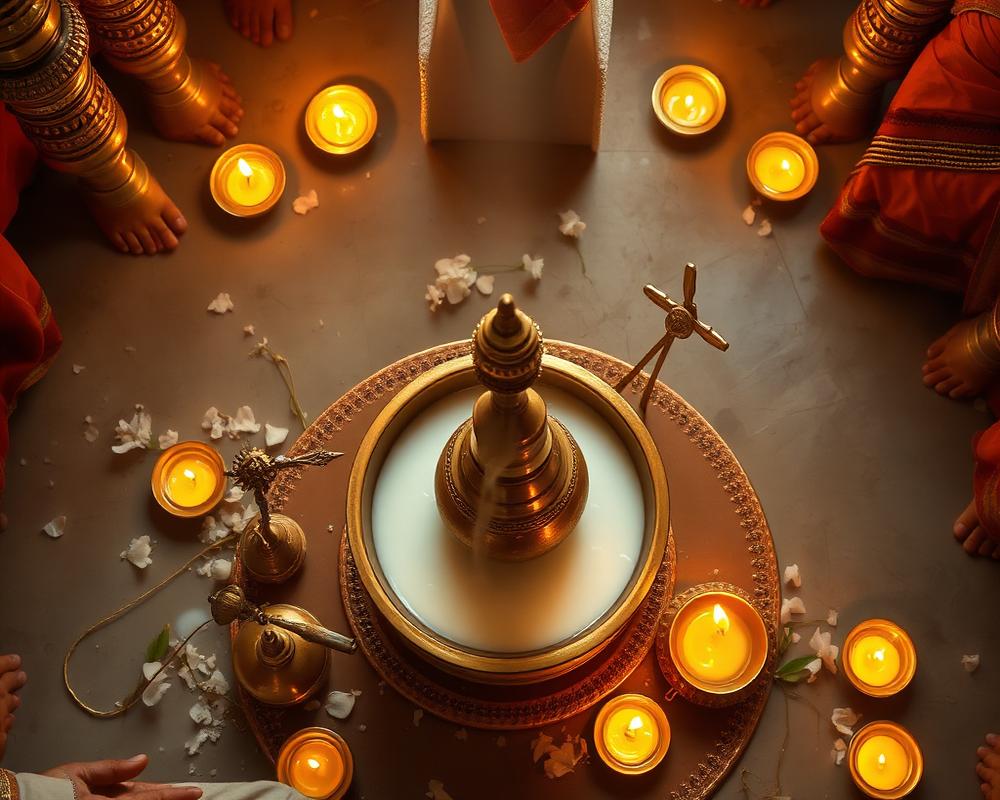
Rudrabhishek is the chanting of the Rudram (from the Krishna Yajurveda) while bathing the Shivling with panchamrit — milk, curd, ghee, honey, sugar — followed by Ganga jal. The mantra Namakam contains the 108 names of Rudra; Chamakam contains the 108 wishes a devotee places before him. Chanting both in a full cycle is called a 'Rudra Yajna'.
The eleven dravyas of abhishek
A complete Rudrabhishek uses eleven dravyas (offerings), each with its own phal (result). Jal (water) for peace of mind. Dugdha (milk) for progeny. Dadhi (curd) for prosperity. Ghrit (ghee) for victory over enemies. Madhu (honey) for a melodious voice. Sharkara (sugar) for happiness. Ganga jal for moksha. Sugandhit tail (fragrant oil) for freedom from disease. Panchamrit for wealth. Ikshu ras (sugarcane juice) for freedom from debt. Bhasma (sacred ash) for freedom from all karma. In Shravan we use all eleven — a full-spectrum abhishek that few pandits still perform correctly.
The role of the bilva patra
Bilva (bael leaf) is the single most important offering in Shravan. Its three leaflets symbolise the trinity — Brahma, Vishnu, Mahesh — and also Shiv's three eyes. Traditional shastra says a leaf must be fresh, unbroken, with the smooth side down when placed on the Shivling. Never pluck bilva after sunset, on Mondays, Chaturdashi, or Amavasya — on those days use leaves plucked and stored the previous day. Old bilva is never discarded in the dustbin; it is returned to a river or the roots of a peepal tree.
The Shravan Somvar vrat
A traditional Somvar vrat begins with a pre-dawn bath in cold water, wearing white or saffron clothes, and a sankalp before an image or Shivling at home. One meal (phalahar — fruits, milk, sabudana, kuttu atta) is taken after sunset. The fast is broken with panchamrit and prasad from an evening Rudrabhishek. Women take the vrat for their husband's long life; unmarried girls for a suitable partner; men and elders for health and peace of ancestors.
Common mistakes we see
First: offering tulsi to a Shivling. Tulsi belongs to Vishnu — the shastra explicitly forbids it on Shiv. Second: placing sindoor or haldi on Shiv (both are for Shakti — chandan and bhasma only for Shiv). Third: skipping the sankalp because 'the pandit will chant it'. The devotee's sankalp is what makes the offering theirs. Fourth: taking the abhishek jal home — it is considered nirmalya and should be poured at the root of a peepal or bilva tree, not consumed.
Booking your Sawan Rudrabhishek
Through our Uttarkashi acharyas you can book a single Somvar Rudrabhishek, a full Sawan sankalp (all four or five Somvars), or a daily Shravan abhishek. Every booking includes your name and gotra in the sankalp, live video darshan on request, and a small parcel of bilva, bhasma and Ganga jal shipped from Uttarkashi after the pooja.
Get your daily Panchang on WhatsApp