
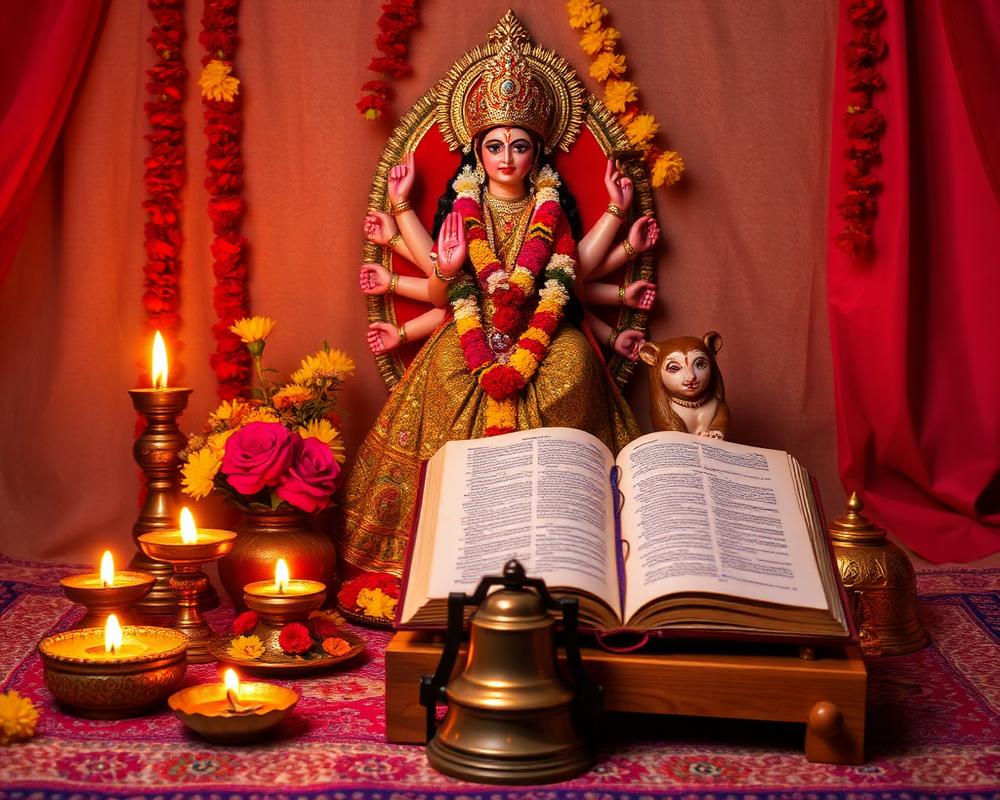
The power of the Durga Saptashati — 700 shlokas of shakti
The Saptashati is not just a text. It is a mantric shield. Chanted with shraddha, it has protected thousands of devotees for generations.
By Dr. Dataram Mishra · 25 March 2026
The Durga Saptashati (also called Chandi Path or Devi Mahatmya) is a 700-verse text extracted from the Markandeya Purana. It contains three charitras (segments) narrating the Devi's slaying of Madhu-Kaitabha, Mahishasura, and Shumbh-Nishumbh.
Why 700 shlokas?
700 is not accidental. Each shloka is itself a mantra — a compressed vibration of Devi's power. Chanted correctly in Sanskrit, each shloka accumulates a specific effect. Together, all 700 in one sitting create what is called a 'Chandi Yajna' — a full shakti awakening.
When to chant it
Traditional times: all nine days of Navratri (once each day), on Ashtami / Navami of any month, at the birth of a girl child, before a difficult undertaking, during a family crisis. Some sadhaks chant it daily as their nitya karma.
The three charitras
Prathama Charitra (Chapter 1) — Devi as Mahakali, slayer of the demons Madhu and Kaitabha at the beginning of time, invoked for cutting through delusion and tamas. Madhyama Charitra (Chapters 2–4) — Devi as Mahalakshmi, slayer of Mahishasura, invoked for prosperity, courage and destruction of internal enemies (anger, lust, greed, pride). Uttama Charitra (Chapters 5–13) — Devi as Mahasaraswati, slayer of Shumbh and Nishumbh, invoked for wisdom, learning and the highest jnana. A full Chandi Path covers all three in a single sitting.
The six ang paths
Along with the 700 shlokas, a proper Chandi Path includes six 'limbs' (angas): Kavach (armour), Argala (bolt), Keelak (nail), Ratri Suktam, Devi Suktam and Devi Atharvasheersham. These are chanted before the main text as a protective enclosure — think of them as building the mandap in which the Devi will manifest. Skipping them is like inviting a guest without preparing the seat.
Chanting rules
Never pause mid-shloka; complete each in one breath if possible. Never chant with unwashed hands or feet. Avoid the path during menstruation or within ten days of a birth/death in the family (in these cases the family may commission the path — a pandit performs it in their name). Never share the physical book with someone who has not been initiated into it. Keep a lit ghee lamp continuously through the recitation.
The Navratri 9-day sadhana
Traditionally the full Saptashati is chanted once each of the nine nights, one for each form of Durga — Shailaputri, Brahmacharini, Chandraghanta, Kushmanda, Skandmata, Katyayani, Kalaratri, Mahagauri and Siddhidatri. Each night has a specific colour (yellow, green, grey, orange, white, red, blue, pink, purple in one popular order), a specific bhog, and a specific wish that is best placed at the Devi's feet that night. Devotees who book our 9-day Navratri sadhana have their name and gotra chanted in the sankalp each evening; a havan on the ninth night concludes the vrat and a small red chunri is shipped as prasad.
For daily nitya karma
If chanting the full 700 shlokas daily is not possible, the shastra allows three shorter cycles: the Devi Atharvasheersham (once), the Argala Stotram (once), or the seed mantra 'Om Aim Hreem Kleem Chamundaye Vichche' (108 times on a rudraksh mala). Any one of these, chanted every morning after bath, keeps the Devi's grace active in the home.
Get your daily Panchang on WhatsApp
More on Sanatan Knowledge
Rudrabhishek in Tricity: Chandigarh, Panchkula & Mohali (Vidhi, Cost & Booking)
Everything about booking a Rudrabhishek in the Tricity — the shastra-vidhi, samagri, cost with and without samagri, and how to book online Rudrabhishek from anywhere in India.
Online Pooja in India: How Booking Works, What You Get & What It Costs
A clear guide to online pooja in India — how sankalp works remotely, which poojas can be done online, prasad courier, pricing, and how to pick the right muhurat.
Talking to Experienced Astrologers: What a Real Kundli Consultation Covers
What to expect from a consultation with experienced astrologers — which details you must share, what a genuine reading covers, and when a handwritten kundli is worth it.